


What Makes a Tractor Run?
Unlocking the Secrets Of Tractor Power
By Tom Seest
At ClassicTractorNews, we help tractor lovers keep up with the latest news for classic and vintage tractors.
Please share this post with your friends, family, or business associates who may like old classic or vintage tractors.
What Makes a Tractor Run?
One of the most important things to consider when operating a tractor is its center of gravity. This is the point at which the tractor’s weight is distributed, and any changes to this point can have serious consequences. For example, if the center of gravity is shifted too far back, the tractor could tip over backward, especially when driving in reverse. This is why it’s crucial to always be mindful of the weight distribution when using tractors with front-end loaders, as raising a load can significantly alter the center of gravity and increase the risk of tipping.
In addition to being mindful of the center of gravity, it’s important to consider the terrain on which you’re operating the tractor. Crossing steep slopes, for example, can also affect the tractor’s stability. When driving on uneven or sloped ground, the risk of the tractor tipping over increases, making it essential to adjust your driving technique and be aware of the potential hazards.
So, whether you’re working on a farm, participating in a tractor parade, or simply enjoying the beauty of these timeless machines, always remember the importance of maintaining the tractor’s stability. Stay tuned to ClassicTractorNews for more essential tips and information to help you make the most of your classic and vintage tractors.

What Makes a Tractor Run?
What Makes a Tractor Run?
- Center of gravity is crucial when operating a tractor.
- Shifting the center of gravity can have serious consequences, such as tipping over.
- Tractors with front-end loaders require mindfulness of weight distribution.
- Terrain, such as steep slopes, can affect tractor stability.
- Adjust driving technique and be aware of potential hazards on uneven ground.
- Maintaining tractor stability is essential for farm work, parades, and enjoyment of these timeless machines.

What Makes a Tractor Run?
Table Of Contents
How Does an Engine Power a Tractor?
In the world of tractors, engines are the heart and soul of these powerful machines. In the early days, engines were powered by solid fuels like wood or coal, but after 1859, the dawn of the petroleum era changed everything. Nowadays, engines use this fuel source to generate electrical energy and drive motors, allowing them to turn wheels and control mechanical implements with ease.
Depending on their size, tractors can run on either gasoline or diesel. Whether large or small, every tractor requires the operator to start them up, allowing the engine and components to warm up for optimal performance before they can tackle their intended tasks. Once they’re fired up and ready to go, tractors are indispensable for a wide range of agricultural and industrial applications.
One crucial feature of a tractor is its power take-off (PTO) shaft located at the rear. This component transfers engine energy to other equipment such as mowers or trimmers, allowing the tractor to perform a variety of tasks. Additionally, most PTO systems come equipped with a hydraulic system that uses oil to power hydraulic cylinders, making it easy to move heavy implements around effortlessly.
Another key feature found in most tractors is the three-point hitch. This hitch connects to the implement via two lower and one upper lift arm, making it simple to attach and detach with minimal effort. This allows the tractor and the implement to function as a single unit, reducing wear on both components and eliminating the need for separate towing links.
For safety, most tractors are equipped with a rollover protective structure (ROPS) designed to prevent operators from being crushed in the event of a rollover. While ROPS are essential safety features, accidents can still occur, so it’s crucial for operators to remain inside the protective frame at all times and always wear their seat belt.
Proper training is essential for anyone operating a tractor. Operators should have a good understanding of their machines and possess the physical and mental capabilities required to perform their jobs efficiently and safely. By following these guidelines, tractor operators can ensure that these powerful machines are used to their full potential while minimizing the risk of accidents and injuries.
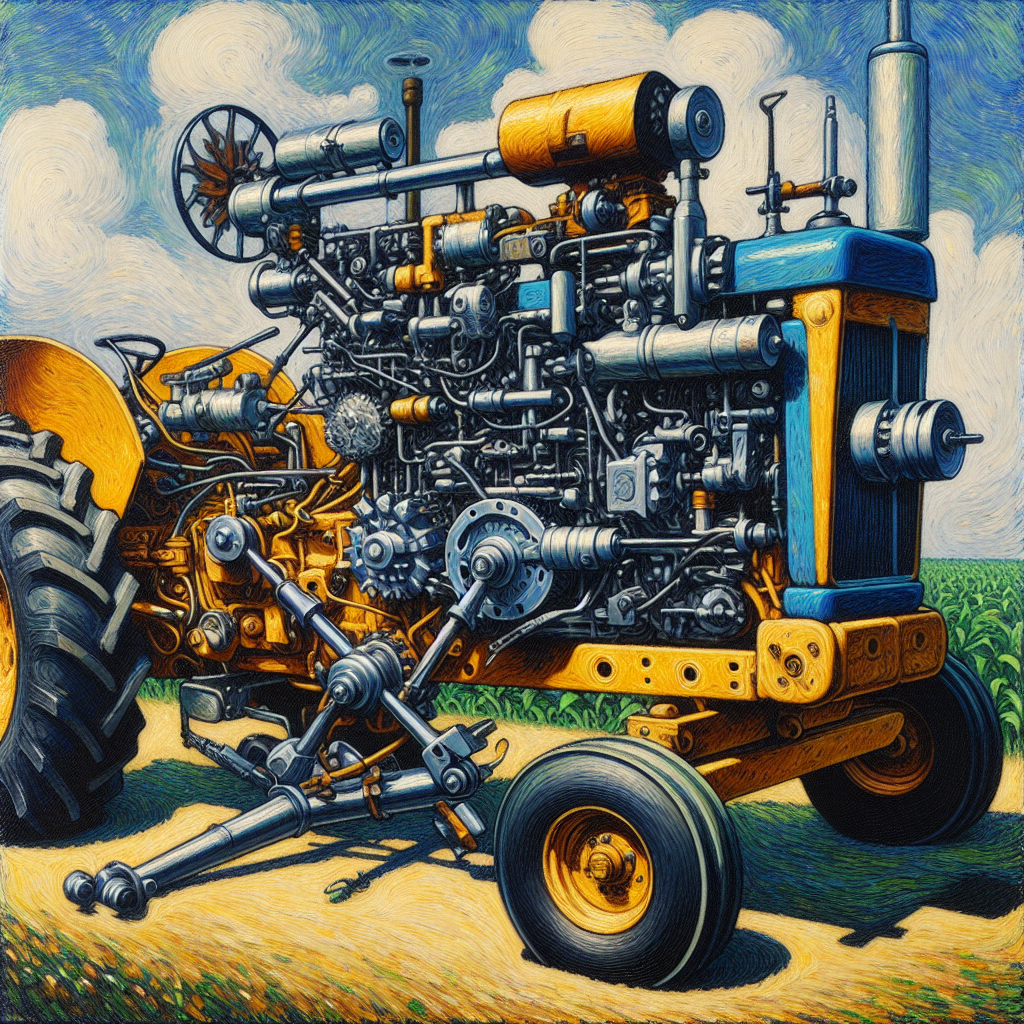
How Does an Engine Power a Tractor?
How Does an Engine Power a Tractor?
- In the world of tractors, engines are the heart and soul of these powerful machines.
- In the early days, engines were powered by solid fuels like wood or coal, but after 1859, the dawn of the petroleum era changed everything.
- Nowadays, engines use this fuel source to generate electrical energy and drive motors, allowing them to turn wheels and control mechanical implements with ease.
- Depending on their size, tractors can run on either gasoline or diesel.
- One crucial feature of a tractor is its power take-off (PTO) shaft located at the rear.
- Another key feature found in most tractors is the three-point hitch.
- Proper training is essential for anyone operating a tractor.

How Does an Engine Power a Tractor?
What Powers the Tractor’s Transmission?
Tractors are versatile machines primarily used in agricultural and industrial settings. Most of these powerful vehicles are equipped with manual transmissions that have multiple gear ratios, which enable them to operate at various speeds. By combining these gear ratios with variable engine throttle speed settings, operators have precise control over the final drive speed, allowing them to move at speeds ranging from as low as one mph to approximately 25 miles per hour.
In addition to their gear functionality, tractors also come with power take-off (PTO) components. These components work in conjunction with the gears to provide constant power for a variety of equipment, including buzz saws, threshing machines, silage blowers, and stationary balers being towed. The PTO utilizes grooves on its output shaft to spin the attached implements at an adjustable rate, making it a crucial part of the tractor’s operation.
Newer tractor models are equipped with intelligent transmissions that allow operators to shift gears without the need to use the clutch pedal. When shifting into lower gears, the transmission increases the engine’s revolutions per minute (rpm) to deliver maximum power to the PTO. Conversely, shifting back up into higher gears decreases the engine power to reduce fuel consumption, making the operation more efficient and cost-effective.
On the other hand, older tractor models with unsynchronized transmission designs require their operators to engage the clutch when changing gears. This method has been proven to be dangerous and has since been replaced by more modern methods like double clutching or power shifting for enhanced safety and efficiency.
Tractors are capable of performing a wide range of tasks, from clearing land and lifting heavy objects to landscaping and even driving on roads. These versatile machines can be equipped with a variety of attachments, including mowers, garden tillers, augers, or snow blowers, expanding their functionality and usefulness in different settings.
For operators working in hazardous terrain or extreme weather conditions, enclosed cabs offer better safety and protection. Some tractor models even feature tracks instead of wheels, allowing them to maneuver in even deeper snow or on more challenging surfaces, further enhancing their versatility and adaptability.

What Powers the Tractor’s Transmission?
What Powers the Tractor’s Transmission?
- Tractors are versatile machines used in agricultural and industrial settings.
- They are equipped with manual transmissions with multiple gear ratios.
- Tractors also come with power take-off (PTO) components.
- Newer models have intelligent transmissions for shifting gears without using the clutch pedal.
- Older models with unsynchronized transmission designs require operators to engage the clutch when changing gears.
- Tractors are capable of performing a wide range of tasks with various attachments.
- Enclosed cabs and tracks on some models offer better safety and adaptability.

What Powers the Tractor’s Transmission?
The Power of Hydraulics: How Does it Work?
Hey there, folks. If you’ve ever seen heavy machinery at work, chances are it’s powered by hydraulics. Let’s talk about the incredible force behind hydraulic systems and how they’re used in modern tractors.
A hydraulic system is made up of multiple cylinders filled with oil or water. When pressure is applied to one piston in a cylinder, it generates force at the other end, making it possible for hydraulic lift systems to handle massive weights.
Tractors use hydraulic systems to power a variety of equipment attachments. With a standard three-point hitch at the rear, implements from different manufacturers can be easily attached, making lowering and raising a breeze. No need for separate PTO shafts for every attachment.
When a tractor is connected to an implement, its hydraulic system transports pressurized fluid from the engine or electric motor through various lines to an actuator at the back. A hydraulic cylinder or motor then turns that pressure into mechanical energy, allowing the actuator to lift or push as needed. Once the task is done, everything returns to its original position, with the fluid being sent back to the reservoir.
Modern tractors are equipped with remote valves, making it easy for operators to control different functions without leaving their seat. This comes in handy when adjusting or maneuvering over uneven terrain. When it comes to safety, many tractors are built with ROPS (rollover protection structure) to prevent injury in the event of an overturn, with an extendable steel beam covering the operator’s seat.

The Power of Hydraulics: How Does it Work?
The Power of Hydraulics: How Does it Work?
- Hydraulic systems power heavy machinery and modern tractors.
- Hydraulic system uses oil or water in multiple cylinders.
- Tractors use hydraulic systems to power equipment attachments.
- The hydraulic system transports pressurized fluid to the actuator at the back of the tractor.
- Modern tractors are equipped with remote valves for easy operator control.
- Many tractors are built with ROPS for operator safety in case of overturn.
- Hydraulic systems offer power and versatility in modern tractors.

The Power of Hydraulics: How Does it Work?
Unlocking the Power of the Tractor’s PTO
When it comes to getting the most out of a tractor, it all comes down to the power take-off or PTO. This nifty little feature is what gives tractors that extra bit of versatility beyond just moving stuff from one place to another. With a PTO, a tractor can power all sorts of auxiliary equipment for doing work on the job site, like plowing, harrowing, discrowing, and planting operations. That means it saves both money and space – two things that are always in short supply.
However, the real game-changer with a PTO is that it can eliminate the need for separate engines to power equipment. That’s a big deal, because it reduces costs significantly and saves even more space at the same time. It’s like getting two for the price of one!
Over time, PTO systems have gone through some changes, but the basic principles are still the same. Here’s how it works: a PTO stub shaft on a tractor transfers power from the engine to an implement. The transmission is what controls whether or not the power is running to the implement. More modern tractors use what’s called “live PTO designs,” which means the rotation of the PTO is independent of the vehicle’s motion. This is a much more efficient design compared to the older non-live PTO designs that required operators to manually shift gears while running and could even damage the transmission.
However, with all its benefits, there are some serious dangers to be aware of when it comes to PTOs. Tractor-related accidents that result in serious and fatal injuries often involve people getting caught in rotating PTO shafts. This could happen if someone steps in front of machinery, gets on or off a tractor, reaches for control levers from their seat, or is riding when the PTO is operating.
The real danger of PTO shafts is when they’re operating at half or one-quarter of their recommended speed. Clothing can get wrapped around them in the blink of an eye, and before you know it, someone’s trapped between the chassis, the body, or moving parts and getting crushed or worse. PTO shafts are serious business, and they have the potential to crush, cut, or burn individuals if they’re not handled with care.

Unlocking the Power of the Tractor’s PTO
Unlocking the Power of the Tractor’s PTO
- Power take-off (PTO) is a key feature of tractors for powering auxiliary equipment.
- PTO eliminates the need for separate engines for equipment, saving costs and space.
- PTO systems have evolved, with modern tractors using more efficient “live PTO” designs.
- PTO can be dangerous, with many tractor-related accidents involving people getting caught in rotating PTO shafts.
- Dangers of PTO include clothing getting wrapped around shafts and potential for serious injuries.
- PTO shafts have the potential to crush, cut, or burn individuals if not handled with care.

Unlocking the Power of the Tractor’s PTO
How Does a Tractor’s Seat Help Operators?
Ah, the operator’s seat of a tractor. A critical component, wouldn’t you say? After all, it’s where the magic happens – where comfort meets efficiency, ride quality, and even energy usage. Picture this: you’re driving your tractor over rough terrain, no load on board, and you’re feeling every bump and jolt. Doesn’t sound like much fun, does it? But, with an adjustable, suspended seat featuring a backrest and suspension system, suddenly, the ride is smoother, and the energy you’re expending is more effectively used. That’s the power of a well-designed tractor seat.
Now, let’s talk a bit about tractors themselves. These powerful machines are indispensable in the farming and construction industries. They do it all – from hauling loads of dirt and debris to drilling holes for posts and foundations, to mowing lawns, and so much more. Tractor attachments like backhoes and excavators make quick work of clearing away debris and digging trenches. But, before we let any new operators loose with these powerful machines, they need to be properly trained. Human factors and engineering principles come into play here. It’s about adapting the working environment to the individual worker and ensuring their safety and effectiveness while operating the equipment.
Of course, safety is always a top priority. Loose clothing and long hair can spell disaster if they become entangled in moving parts or PTO shafts. And let’s not forget the risk of overturning the tractor, especially on rough ground or when making high-speed turns. It’s all too easy for these notoriously unstable vehicles to tip over, especially when wheels are positioned closely together. The last thing we want is to see a tractor’s rear end elevated or tipping over completely.
For anyone interested in vintage tractor seats, we’ve got you covered. Share this post with your friends, family, and business associates who appreciate the classics, and be sure to follow us for more on vintage tractor seats and other agricultural equipment. And remember to always put safety first when operating any heavy machinery.

How Does a Tractor’s Seat Help Operators?
How Does a Tractor’s Seat Help Operators?
- The operator’s seat of a tractor is a critical component for comfort and efficiency.
- An adjustable, suspended seat with a backrest and suspension system provides a smoother ride and more effective energy usage.
- Tractors are indispensable in farming and construction industries, performing a wide range of tasks.
- Proper training and consideration of human factors and engineering principles are essential for tractor operators.
- Safety is a top priority when operating tractors, including consideration for loose clothing and the risk of overturning.
- We cover vintage tractor seats and other agricultural equipment for those interested in classics.
- Always prioritize safety when operating heavy machinery.

How Does a Tractor’s Seat Help Operators?
Conclusion
Hey there, classic tractor enthusiasts! As we wrap up our discussion on the secrets of tractor power, it’s important to remember the crucial factors that keep these machines running smoothly and safely. Tractors are powerful and versatile, but they also require careful attention to their center of gravity, especially when using front-end loaders or operating on steep slopes. To maximize the efficiency and safety of tractors, it’s essential to maintain stability and be aware of potential hazards in any operating conditions.
Engines are the heart and soul of tractors, generating electrical energy and driving motors that power the machinery. The power take-off (PTO) and three-point hitch are key features that allow tractors to transfer energy to various attachments, making them invaluable for a wide range of agricultural and industrial tasks. It’s crucial to remember to always prioritize safety and proper training when using these powerful machines, ensuring that they are used to their full potential while minimizing the risk of accidents and injuries.
Tractors are equipped with manual transmissions, power take-off (PTO) components, and hydraulic systems that make them versatile and adaptable to different tasks and terrains. The power take-off, or PTO, is a hidden gem in the world of tractors, providing the extra versatility needed to power auxiliary equipment and eliminate the need for separate engines for various tasks. While PTOs offer numerous benefits, it’s important for operators to be aware of the potential dangers and safety risks associated with PTO shafts, ensuring that they are handled with care and attention to prevent accidents and injuries.
The operator’s seat of a tractor is a critical component that affects comfort, efficiency, and ride quality for the operator. Properly designed tractor seats play a crucial role in ensuring a smooth and comfortable ride for the operator, optimizing energy usage, and minimizing the impact of rough terrain. Tractors are powerful and indispensable in various industries, but proper training and safety measures are essential to prevent accidents and ensure the effective and safe operation of these machines.
In conclusion, tractors are powerful and versatile machines that require careful attention to safety, stability, and proper training for operators. With the right knowledge and understanding of their capabilities and risks, tractors can be used to their full potential while minimizing the potential for accidents and injuries. Thanks for tuning in, and until next time, stay safe and keep on learning!

Conclusion
Conclusion:
- Tractors require careful attention to their center of gravity.
- Engines are the heart and soul of tractors.
- The power take-off (PTO) and three-point hitch are key features.
- Tractors are equipped with manual transmissions, PTO components, and hydraulic systems.
- The operator’s seat of a tractor is a critical component.
- Proper training and safety measures are essential for the effective and safe operation of tractors.
- Tractors require careful attention to safety, stability, and proper training for operators.

Conclusion
Other Resources

Other Resources
Here’s a list of articles that explain what makes a tractor run:
- “How do tractors work?” from Explain that Stuff. This article provides an in-depth look at the mechanics of tractors, including their engines, tires, and other parts.
- “How Does A Tractor Work” from Tractor Parts & Repair. It discusses the different parts of a tractor and how they work together to perform agricultural tasks.
- “Pulling 101” from National Tractor Pullers Association (NTPA). While not directly about the functioning of tractors, this article gives insight into the sport of tractor pulling, which showcases the power and capabilities of tractors.
These articles should give you a comprehensive understanding of the various aspects that enable tractors to operate effectively.

Other Resources
At ClassicTractorNews, we help tractor lovers keep up with the latest news for classic and vintage tractors.
Please share this post with your friends, family, or business associates who may like old classic or vintage tractors.